The competitor field, scored
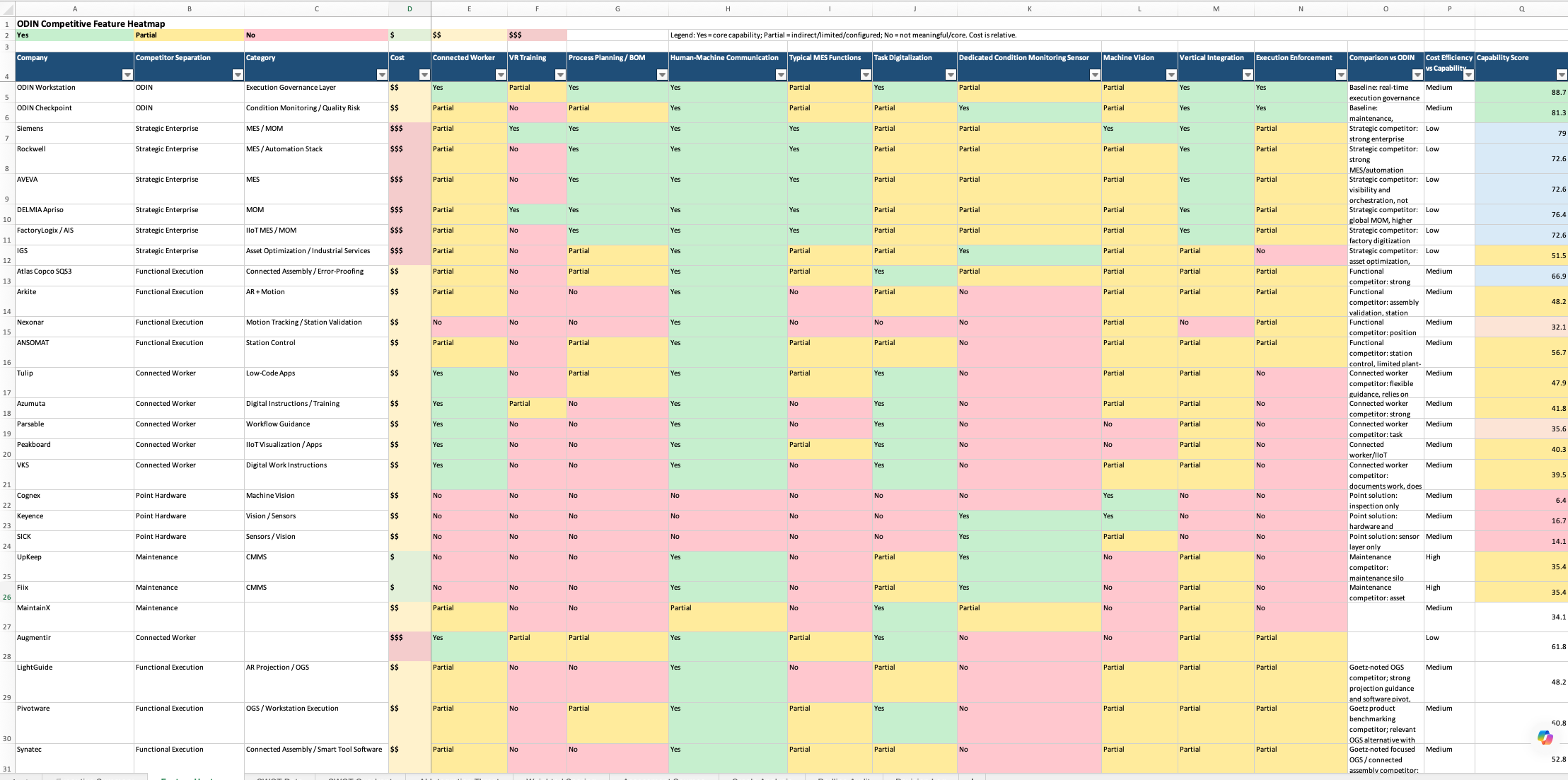
Stanley Tan's competitive assessment (version 4) maps thirty players across six groups and scores them on a weighted execution model. It is the most current competitive read ODIN holds. It does not change the category. It validates it: the sales organisation, independently, has converged on execution governance as the differentiator, which is enforced assembly named from the field.
The assessment as it was scored
The full competitive matrix as Stanley Tan scored it in version 4: the players, the weighted capabilities and the cost-adjusted ranking. The reading on this page is drawn directly from it.
Who competes, and where ODIN governs instead
Each group solves part of the floor. None governs execution at the workstation across the whole process. That gap is the category.
The two heaviest tests are the ones ODIN owns
The assessment weights nine capabilities. The two highest-weighted, both rated critical, are execution enforcement and operator-and-machine governance: thirty-five per cent of the score, and the heart of enforced assembly. ODIN scores five; the enterprise, maintenance and connected-worker classes score one.
| Capability | Weight | ODIN | Enterprise MES | Oracle Mtce | Connected worker | Functional | Point hardware |
|---|---|---|---|---|---|---|---|
| Real-time execution enforcement | 20% | 5 | 1 | 1 | 1 | 3 | 0 |
| Operator + machine governance | 15% | 5 | 1 | 2 | 1 | 3 | 0 |
| Validation integration | 10% | 5 | 2 | 3 | 1 | 4 | 3 |
| Human-machine communication | 10% | 5 | 3 | 3 | 4 | 2 | 1 |
| Condition monitoring + escalation | 8% | 5 | 2 | 5 | 1 | 1 | 2 |
| MES / enterprise integration | 8% | 4 | 5 | 5 | 2 | 1 | 0 |
Nine capabilities scored in the source; the six heaviest shown. ODIN trails only on enterprise integration, by design: it governs execution and connects up, rather than being the system of record.
The single pane of glass is the unenforced line in modern dress
Version 4 adds the AI integration and orchestration threat: platforms that promise to unify MES, ERP, CMMS and QMS into one view. The assessment is clear that this solves visibility, not governance. The distinction is the category.
One view of everything
- AI unifies the systems into a single pane of glass.
- It routes alerts and data between systems automatically.
- Copilots recommend the next action.
Observation is not authority
- A dashboard can observe execution. ODIN governs it.
- Moving data faster is not the same as controlling execution.
- Advice is not authority. Visibility without governance still leaves the risk on the line.
It confirms the category and quantifies the moat
The sales org named enforced assembly from the field
Version 4 runs on execution governance, execution enforcement and workstation governance throughout. That is the category's core mechanic, reached independently by the people who sell ODIN. Independent convergence from sales is strong evidence the category is real and sellable.
The heaviest, most critical tests are the enforced-assembly tests
Execution enforcement and operator-machine governance carry the most weight and are rated critical. ODIN scores five; MES, Oracle and connected-worker classes score one. The moat is not a slogan, it is the top of the scorecard.
The single pane of glass joins the unenforced line
The AI orchestration threat is the villain in current language: it observes and coordinates, it does not govern. "A dashboard can observe execution. ODIN governs it." belongs in the POV and the launch.
These are internal sales scores
The weighting and the scores are a sales assessment, not an independent benchmark. They strengthen the internal case and the narrative. Public enforcement claims still pass through Hume's bounded device-layer check before they ship.